 YOU ARE SHOPPING ON OUR


Concealed Carry Holster Guide
Concealed Carry Holster Types and Terminology Explained
Terms such as IWB, OWB, shoulder holster, ankle holster and concealed carry appear frequently in international firearm and equipment content, particularly material written for the United States.
Understanding what these terms mean can be useful when comparing professional equipment, but Australian firearm laws and licensing operate under a different framework. Overseas concealed-carry terminology should not be treated as guidance on where or how firearms may legally be carried in Australia.
Quick answer: Common holster terminology includes IWB for inside-the-waistband, OWB for outside-the-waistband, shoulder holsters, thigh or drop-leg systems and MOLLE-mounted holsters. These terms describe equipment position or mounting style, not whether carrying a firearm is lawful. Australian users should follow applicable state or territory law, licensing conditions and professional requirements.
What Does Concealed Carry Mean?
“Concealed carry” is a term used extensively in the United States to describe carrying a firearm so that it is not readily visible.
The term appears across international firearm, tactical clothing and holster discussions, which is why Australian customers may encounter it when researching equipment online.
Australian context: Australia does not operate the broad US-style civilian concealed-carry framework. Firearm possession, carrying and use depend on state or territory legislation, licensing, lawful purpose and specific conditions.
For Australian legal context, refer to current official firearms guidance for your jurisdiction rather than applying US CCW advice locally.
Common Holster Types at a Glance
| Holster Type | What the Term Means | Main Equipment Consideration |
| IWB | Inside the waistband | Waistband space, belt compatibility and mounting hardware |
| OWB | Outside the waistband | Belt support, mounting system and other external equipment |
| Shoulder Holster | Harness-mounted system around the upper torso | Harness fit, clothing and other body-worn equipment |
| Thigh / Drop-Leg | Equipment platform positioned around the upper leg | Stability, belt connection and movement |
| MOLLE Holster | Holster designed to attach to compatible modular webbing | Platform compatibility, retention and equipment layout |
| Ankle Holster | Lower-leg-mounted system | Clothing, footwear and specialised authorised use |
What Does IWB Mean?
IWB means inside the waistband.
Most of the holster body sits between the wearer and the waistband while clips, loops or other mounting hardware secure the system to the belt or clothing.
IWB is therefore primarily a description of the equipment's mounting position.
When assessing an IWB product, relevant equipment factors include:
- Belt width
- Mounting hardware
- Waistband room
- Holster thickness
- Retention
- Clothing fit
For a direct comparison with external systems, see our guide to IWB vs OWB holsters.
What Does OWB Mean?
OWB means outside the waistband.
The holster mounts externally to a belt or another compatible waist-mounted platform.
OWB systems can use different mounting methods, including:
- Belt loops
- Paddle-style mounts
- Dedicated duty mounts
- Drop or offset platforms
Because the equipment sits outside the waistband, belt structure and interaction with other equipment can become particularly important.
What Is a Shoulder Holster?
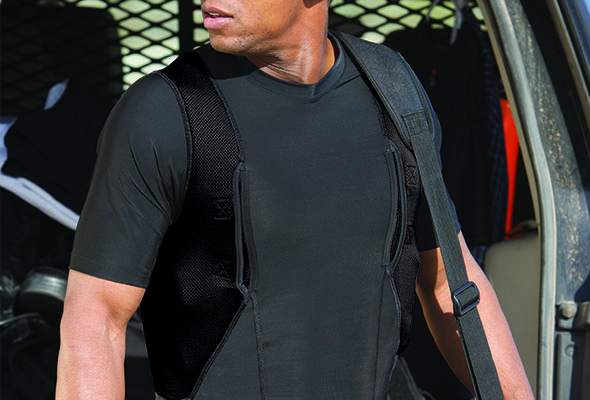
A shoulder holster uses a harness around the upper torso rather than relying solely on the waistband.
This type of equipment interacts differently with:
- Jackets
- Uniform shirts
- Load-bearing equipment
- Harnesses
- Other torso-mounted equipment
Professional users should assess shoulder-mounted systems according to manufacturer instructions and organisational requirements.
What Is a Thigh or Drop-Leg Holster?
A thigh or drop-leg system positions compatible equipment lower than a conventional waist-mounted platform.
It normally uses a connection to the belt combined with straps or a platform around the upper leg.
This type of setup can create additional equipment space where the waist is already occupied by pouches, protective equipment or other professional gear.
The current 5.11 Thigh Rig is a live Australian example of a MOLLE/SlickStick®-compatible leg platform built from 500D nylon. :contentReference[oaicite:0]{index=0}
What Is a MOLLE Holster?
MOLLE describes a modular attachment system rather than a particular body position.
A compatible holster can attach to MOLLE webbing on equipment such as:
- Battle belts
- Duty equipment
- Plate carriers
- Tactical vests
- Compatible bags
The current 5.11 AU LBE Holster, for example, uses MOLLE / 5.11 SlickStick® compatibility, 1050D nylon and an adjustable retention system. It is currently listed as out of stock. :contentReference[oaicite:1]{index=1}
What Is the 5.11 Holster Pouch?
The current 5.11 Holster Pouch takes a different approach from a rigid model-specific holster.
It uses the 5.11 TacTec® system and adjustable locking straps, allowing the pouch dimensions to be configured around compatible equipment. It attaches to loop panels built into selected 5.11 apparel and bags. :contentReference[oaicite:2]{index=2}
This is a useful example of the difference between:
- A rigid product designed around a specific shape
- An adjustable textile holster system
Holster Terminology Explained
International holster discussions use a lot of specialist terminology. Some of it relates to equipment construction, while other terms come specifically from US concealed-carry culture.
| Term | Meaning |
| Retention | How securely compatible equipment is held within the holster |
| Cant | The angle at which the holster or equipment is positioned |
| Ride Height | How high or low the holster sits relative to its mounting platform |
| Paddle | A broad mounting interface used by some external holster systems |
| Belt Loop | A mount that interfaces directly with the belt |
| MOLLE | A modular webbing-based attachment system |
| Drop / Offset | A mount that positions equipment lower or further away from the belt |
What Is Holster Retention?
Retention is one of the most important holster concepts because it describes how securely compatible equipment remains within the system.
Retention can involve:
- Friction
- Adjustable straps
- Hook-and-loop systems
- Mechanical retention mechanisms
- Multiple systems working together
Do not assume that “Level I, II or III” means exactly the same thing across every manufacturer. Retention terminology and testing can differ between product systems, so use the individual manufacturer's specifications and your organisation's requirements.
This corrects an important weakness in the old article, which treated retention levels as though they were one universal standard.
What Is Cant?
Cant refers to the angle of the holster relative to its mounting position.
Some mounting systems offer fixed positioning, while others provide a degree of adjustment.
For professional equipment, any adjustment should remain within manufacturer instructions and organisational policy.
What Is Ride Height?
Ride height describes how high or low the holster sits relative to the belt or mounting platform.
Different mounting hardware can change ride height without changing the holster itself.
This matters because the complete equipment system may also include:
- Pouches
- Body armour
- Jackets
- Radios
- Medical equipment
- Other belt-mounted accessories
Moulded vs Adjustable Holsters
| Feature | Moulded / Model-Specific | Adjustable Textile / Universal |
| Fit | Designed around specific dimensions | Designed to accommodate a broader compatible range |
| Adjustment | Usually limited around the equipment body | Can allow greater dimensional adjustment |
| Material | Often rigid polymer or leather | Often nylon or other technical textiles |
| Example | Depends on model | 5.11 Holster Pouch / LBE Holster style systems |
Why the Tactical Belt Matters
Waist-mounted equipment depends heavily on the support platform.
A purpose-built tactical belt can provide more structure and adjustment than an ordinary fashion belt.
Important factors include:
- Belt width
- Rigidity
- Buckle construction
- Pants-loop compatibility
- Total equipment weight
5.11 Australia currently offers a broad belt assortment including TDU®, Maverick, Sierra Bravo and other duty or everyday systems through the Tactical Belts range. :contentReference[oaicite:3]{index=3}
Holsters and Load-Bearing Equipment
Holsters can also form part of a wider load-bearing system.
The broader 5.11 AU Accessories range includes plate carriers, tactical vests, equipment belts, pouches and other modular gear. :contentReference[oaicite:4]{index=4}
When multiple items share the same platform, consider:
- Available mounting space
- Total load
- Equipment interference
- Retention
- Comfort
- Organisational requirements
More attachment space does not automatically create a better setup. Equipment should be added because it serves a real role, not simply because MOLLE space is available.
Holster Types and Australian Law
Many holster terms found online are closely associated with US civilian concealed-carry culture.
Australian users should separate the equipment terminology from the legal question of whether that equipment may be carried or used in a particular circumstance.
Firearm laws, licensing and lawful purposes vary between Australian states and territories.
Professional users can also be subject to:
- Employer policy
- Approved equipment lists
- Retention requirements
- Uniform requirements
- Formal training
Common Holster Terminology Mistakes
Assuming IWB Means Legal Concealed Carry
IWB describes equipment placement. It does not determine whether carrying a firearm is lawful.
Assuming OWB Means a Duty Holster
OWB simply means outside the waistband. Duty holsters are a more specific professional equipment category.
Assuming MOLLE Is a Holster Type
MOLLE is an attachment platform. A compatible holster or pouch still provides the actual retention.
Assuming Retention Levels Are Universally Standardised
Terminology can vary by manufacturer. Check the specific product and organisational requirements.
Using US Concealed-Carry Terminology as Australian Legal Advice
Australian firearm laws operate under a different licensing and lawful-purpose framework.
Frequently Asked Questions About Holster Types
What are the main types of holsters?
Common systems include IWB, OWB, shoulder, thigh or drop-leg, ankle and MOLLE-mounted holsters. These terms generally describe equipment placement or mounting style.
What does IWB stand for?
IWB means inside the waistband.
What does OWB stand for?
OWB means outside the waistband.
What is the difference between IWB and OWB?
IWB positions most of the holster inside the waistband, while OWB positions it externally on the belt or another waist-mounted platform.
What is a MOLLE holster?
A MOLLE holster is designed to attach to a compatible modular webbing platform such as a tactical vest, plate carrier or equipment belt.
What is holster retention?
Retention describes how securely compatible equipment remains held within the holster.
What is holster cant?
Cant refers to the angle of the holster relative to its mounting position.
What is ride height?
Ride height describes how high or low a holster sits relative to its mounting platform.
Does Australia have concealed carry?
Australia does not operate the broad US-style civilian concealed-carry framework. Firearm possession and carrying depend on state or territory legislation, licensing, lawful purpose and applicable conditions.
Understand the Equipment Before Choosing the System
Holster terminology becomes much easier to understand once you separate three questions:
Where does it mount? IWB, OWB, shoulder, thigh or another position.
How does it attach? Belt loops, clips, paddle, MOLLE or another compatible interface.
How does it retain compatible equipment? Friction, straps, hook-and-loop or mechanical systems.
For Australian professional users, those equipment decisions then need to sit within applicable law, approved organisational policy and formal training.
Explore current 5.11 Tactical Gear, compare 5.11 Tactical Belts, or see the current 5.11 Holster Pouch.