 YOU ARE SHOPPING ON OUR


How to Choose the Right Holster System
Choosing a holster is about more than deciding where equipment sits on the body. The right system needs to work with your belt, clothing, load-bearing equipment, retention requirements and professional role.
For Australian professional users, approved equipment, organisational policy, applicable law and formal training should always take priority over personal preference or overseas concealed-carry advice.
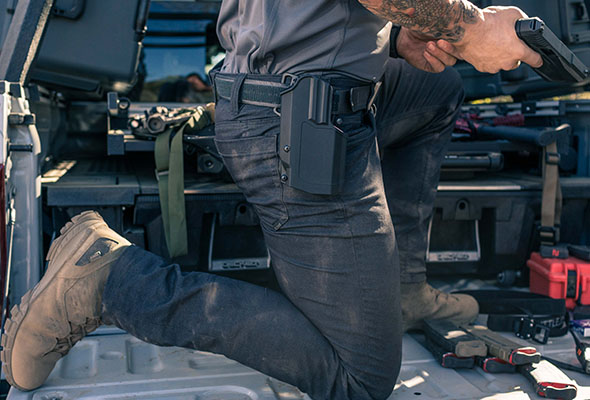
Quick answer: Start with the equipment and role, then choose a holster with appropriate retention and a mounting system that works with your belt, clothing or load-bearing platform. Waist-mounted, thigh-mounted, vest-mounted and shoulder systems all solve different equipment problems, so there is no single best holster for every user.
What Should You Look for in a Holster?
A good holster should be compatible with the specific equipment it is designed to retain and with the platform it attaches to.
Important considerations include:
- Equipment compatibility
- Retention
- Mounting system
- Belt width
- Clothing compatibility
- Interaction with other equipment
- Durability
- Comfort during prolonged wear
- Professional or organisational requirements
The best holster is not simply the easiest one to access. Secure retention, equipment compatibility and approved use should come first.
Main Types of Holster Systems
| Holster System | Mounting Area | Main Consideration |
| Waist / Belt Mounted | Waistband or tactical belt | Belt support, mounting interface and other waist-mounted equipment |
| Thigh / Drop-Leg | Upper leg with connection to the belt | Stability, movement and equipment clearance |
| Vest / MOLLE Mounted | Compatible vest, carrier or MOLLE platform | Platform layout, retention and interference with other pouches |
| Shoulder Mounted | Harness around the upper torso | Fit, outerwear compatibility and authorised use |
| Ankle Mounted | Lower leg | Clothing, footwear and specialised professional requirements |
Belt-Mounted Holsters
Belt-mounted holsters attach to a pants belt, tactical belt or dedicated duty system.
They can use different mounting interfaces, including:
- Belt loops
- Clips
- Paddle-style systems
- Drop or offset mounts
- Dedicated duty-belt adapters
The important part is making sure the holster mount and belt are designed to work together.
The current 5.11 Tactical Belts range includes everyday, Trainer, Operator, TDU®, duty and equipment-belt systems that provide different levels of structure.
Why Belt Rigidity Matters
A belt-mounted system places weight outside or around the waistband, so the belt needs enough structure to hold that equipment consistently.
Consider:
- Total equipment weight
- Belt width
- Rigidity
- Buckle security
- Amount of other equipment mounted to the same belt
A belt used only to support clothing does not necessarily need the same structure as a professional equipment platform.
Inside-the-Waistband vs Outside-the-Waistband
IWB and OWB describe where the holster sits relative to the waistband.
| IWB | OWB |
| Most of the holster sits inside the waistband | Holster mounts outside the waistband |
| Lower-profile equipment arrangement | More external mounting space |
| Requires internal waistband room | Does not occupy the same internal waistband space |
| Mounting hardware must work with the belt and waistband | Belt structure can become more important with heavier external equipment |
For a deeper comparison, see our guide to IWB vs OWB holster systems.
Thigh and Drop-Leg Holsters
A thigh-mounted system positions equipment below the belt line.
This can help create space around the waist where other professional equipment or protective clothing is already being used.
Important considerations include:
- Connection to the belt
- Leg-strap comfort
- Stability during movement
- Clearance from pockets
- Interaction with protective equipment
- Organisational approval
The current 5.11 Thigh Rig provides a 500D nylon MOLLE/SlickStick®-compatible leg platform designed to expand equipment-carrying space. :contentReference[oaicite:1]{index=1}
Vest and MOLLE-Mounted Holster Systems
Some equipment can be mounted directly to a compatible vest, plate carrier or other MOLLE platform.
This creates a modular system where multiple pouches and accessories can be arranged around the user's role.
Consider:
- Available MOLLE space
- Other pouches on the platform
- Retention
- Equipment interference
- Comfort while moving
- Approved organisational setup
The current TacTec® Plate Carrier uses laser-cut loop MOLLE and web MOLLE across a 500D nylon platform, giving compatible accessories multiple mounting options. :contentReference[oaicite:2]{index=2}
5.11 Holster Pouch
The current 5.11 Holster Pouch uses the TacTec® hook-and-loop system and is designed to attach to loop panels built into selected 5.11 apparel and bags.
Its adjustable construction is intended to accommodate a range of compatible equipment sizes, making it different from a rigid moulded holster designed around one exact model. :contentReference[oaicite:3]{index=3}
LBE Compact Holster
The 5.11 LBE Compact Holster provides another approach to modular mounting.
It uses:
- MOLLE / 5.11 SlickStick® compatibility
- 1050D nylon construction
- Hook-and-loop adjustment
- A compact modular design
The product remains live on the Australian website but is currently listed as out of stock. :contentReference[oaicite:4]{index=4}
Shoulder Holsters
A shoulder-mounted system uses a harness around the upper torso instead of relying solely on a waist belt.
That means the system interacts more directly with:
- Jackets
- Uniform shirts
- Body-worn equipment
- Harness fit
- Other torso-mounted equipment
Shoulder systems should be selected and configured according to the manufacturer's instructions and any organisational requirements that apply.
What Is Holster Retention?
Retention describes how securely compatible equipment remains held within the holster.
Different products can use:
- Passive friction
- Hook-and-loop systems
- Straps
- Mechanical retention devices
- Combinations of several systems
The appropriate retention system depends on the equipment and role.
Professional users: retention requirements may be specified by your organisation. Use only approved equipment and follow formal training and manufacturer instructions.
Moulded Holsters vs Universal Holsters
One useful distinction is whether the holster is shaped around specific equipment or designed to adjust around a broader range of compatible items.
| Moulded / Model-Specific | Adjustable / Universal |
| Designed around specific dimensions | Designed to adapt to a broader range of compatible dimensions |
| Can provide precise fit | Provides greater equipment flexibility |
| Compatibility must be confirmed carefully | Adjustment and retention must be configured correctly |
Neither approach is universally better. The correct choice depends on the equipment and professional requirements.
Paddle vs Belt-Loop Holsters
Paddle and belt-loop mounts describe how some OWB holsters attach around the waist.
Paddle Mount
A paddle uses a broader backing piece that interfaces with the waistband or belt area.
Belt-Loop Mount
A belt-loop system passes around or connects directly to the belt.
The appropriate mounting style depends on product compatibility and authorised use rather than simply which one is easiest to remove.
What About Drop and Offset Mounts?
Drop and offset systems position compatible equipment slightly lower or further away from the belt.
This can be useful where other equipment, protective clothing or belt-mounted items would otherwise interfere with the mounting platform.
The current AU Load Bearing Equipment category includes the ThumbDrive® Drop and Offset Kit alongside the Thigh Rig, Combat Belt, LBE Tactical Vest and TacTec® Plate Carrier. :contentReference[oaicite:5]{index=5}
How Tactical Pants Affect Holster Systems
Pants are part of the equipment setup, particularly for belt-mounted systems.
Look at:
- Belt-loop width
- Waistband structure
- Stretch
- Pocket placement
- Cargo-pocket access
- Rise
A large pouch or thigh platform can block a pocket that would otherwise be useful, so evaluate the entire setup rather than the holster alone.
Purpose-built 5.11 Men's Tactical Pants provide multiple storage configurations that can help distribute everyday or professional equipment.
How Plate Carriers Affect Holster Placement
When body-worn equipment is added, available mounting space changes considerably.
A plate carrier can affect:
- Belt access
- Torso movement
- Waist-mounted pouches
- Shoulder systems
- Outerwear
- Other MOLLE-mounted equipment
The goal should be to avoid unnecessary interference between systems rather than trying to fill every available MOLLE position.
How to Choose a Holster System
| Step | Question |
| 1. Identify the Role | Is the system for authorised professional use, training or another approved activity? |
| 2. Check Approved Equipment | Does your organisation specify particular products, mounts or retention systems? |
| 3. Confirm Compatibility | Is the holster designed for the specific equipment? |
| 4. Select the Platform | Belt, thigh, vest/MOLLE or another authorised system? |
| 5. Check Retention | Does the retention system meet the intended requirements? |
| 6. Evaluate the Whole Setup | Does it interfere with clothing, pouches, belts or protective equipment? |
Choosing Holsters in the Australian Context
Many online holster guides are written around US civilian concealed-carry practices.
That is not the correct starting point for Australian users.
Australian users: firearm possession, carrying and use are regulated by state and territory legislation and licensing. Professional users may also be subject to strict organisational policies, approved-equipment requirements and formal training. Overseas concealed-carry recommendations should not be treated as Australian legal or professional guidance.
For Australian 5.11 content, holsters are more usefully understood as part of a broader professional equipment and load-bearing system.
Common Holster Buying Mistakes
Choosing by Placement Alone
Where a holster mounts is only one part of the decision. Retention and compatibility matter just as much.
Ignoring the Belt or Platform
A holster can only perform as intended if the support platform is appropriate.
Assuming Universal Fit
Not every holster works with every item or mounting interface.
Adding Equipment Without Checking Interference
Other pouches, clothing and protective equipment can affect the usable mounting area.
Choosing More MOLLE Because It Looks More Versatile
Modularity is useful only when you actually need additional configurable equipment.
Using Overseas Civilian-Carry Advice as Australian Guidance
Australian laws and professional requirements operate under a different framework.
Frequently Asked Questions About Choosing a Holster
What should I look for when choosing a holster?
Start with compatibility, retention and approved use. Then evaluate mounting platform, belt compatibility, clothing and interaction with the rest of your equipment.
What are the main types of holsters?
Common systems include belt or waistband-mounted, thigh-mounted, vest/MOLLE-mounted, shoulder and specialised lower-leg systems.
What is the difference between IWB and OWB?
IWB places most of the holster inside the waistband, while OWB mounts it outside the waistband or belt.
What is a MOLLE holster?
A MOLLE-compatible holster attaches to a compatible modular webbing platform such as an equipment belt, vest or carrier.
What is a drop-leg holster?
A drop-leg system positions equipment on the upper thigh and generally connects back to the belt for support.
What is holster retention?
Retention describes how securely compatible equipment is held within the holster. Different products use friction, straps, mechanical devices or other systems.
Do all holsters fit all tactical belts?
No. Belt width and mounting-system compatibility need to be checked for each product.
Can a holster attach to a plate carrier?
Some compatible MOLLE or hook-and-loop systems can mount to appropriate carrier platforms, provided the product and organisational requirements allow it.
What is the difference between a holster and a thigh rig?
A holster is designed to retain specific compatible equipment. A thigh rig is a mounting platform that can support compatible pouches or accessories around the leg.
Choose the Holster Around the Equipment System
The right holster is not just a question of where it sits.
Start with the equipment, role and retention requirements. Then choose a mounting platform that works with your belt, pants, vest or carrier and the rest of your approved equipment.
For Australian professional users, applicable law, organisational policy and approved training should always determine how professional equipment is selected and configured.
Explore the current 5.11 Tactical Gear, compare 5.11 Tactical Belts, or browse the 5.11 Load Bearing Equipment range.