IWB vs OWB Holsters: What's the Difference?
IWB and OWB describe two different ways a holster system interfaces with the waistband and belt. IWB means inside the waistband, while OWB means outside the waistband.
The main differences are profile, comfort, clothing compatibility and how the holster attaches to the belt system. For Australian professional users, the appropriate equipment and configuration should always follow applicable laws, organisational policy, approved equipment requirements and formal training.
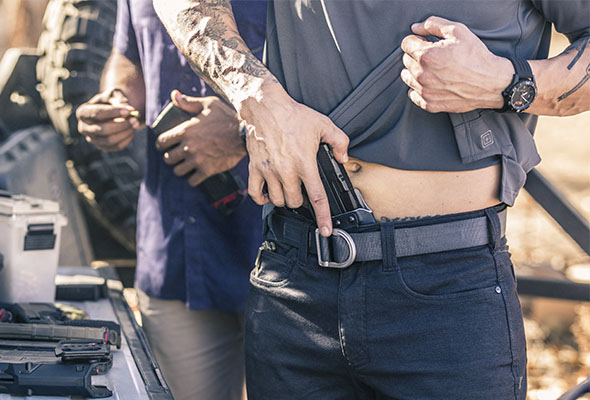
Quick answer: IWB holsters sit between the wearer and the waistband, creating a lower-profile system. OWB holsters mount outside the waistband or belt and generally provide more separation from the body and easier compatibility with larger mounting systems. The right choice depends on authorised use, clothing, belt compatibility, retention requirements and professional policy.
What Does IWB Mean?
IWB stands for inside the waistband.
An IWB holster is designed so most of the holster body sits inside the waistband while a clip, loop or other mounting system connects it to the belt or clothing.
This creates a relatively low-profile equipment setup.
Important considerations include:
- Holster thickness
- Mounting hardware
- Belt width
- Waistband space
- Clothing fit
- Retention
- Comfort while sitting and moving
What Does OWB Mean?
OWB stands for outside the waistband.
An OWB holster mounts externally to the belt or other compatible mounting platform.
Because the holster sits outside the clothing rather than between the waistband and body, OWB systems can offer more space for structured mounting hardware and professional equipment configurations.
Consider:
- Belt strength
- Mounting-system compatibility
- Retention requirements
- Interaction with outerwear
- Other equipment carried around the waist
- Professional uniform requirements
IWB vs OWB at a Glance
| Feature | IWB | OWB |
| Mounting Position | Inside the waistband | Outside the waistband |
| Profile | Generally lower profile | Generally more externally visible |
| Waistband Space | Requires room inside the waistband | Does not occupy the same internal waistband space |
| Belt Requirement | Depends on holster and equipment weight | A structured belt can become more important with heavier external equipment |
| Mounting Options | Typically clips or loops designed around waistband use | Can include belt loops, paddles or dedicated professional mounting systems |
| Best Starting Point | Lower-profile equipment setup | External professional or equipment-focused setup |
Is IWB More Low Profile Than OWB?
Generally, yes.
Because much of the holster sits inside the waistband, IWB systems usually create less external bulk than an OWB platform.
However, overall profile still depends on:
- The holster design
- Mounting hardware
- Clothing
- Belt construction
- The dimensions of the compatible equipment
Two products described as IWB can therefore feel and fit very differently.
Is OWB More Comfortable Than IWB?
Not automatically.
OWB equipment does not occupy internal waistband space, which some users may find more comfortable, particularly during prolonged wear.
However, comfort also depends on:
- Belt rigidity
- Equipment weight
- Mount position permitted by the organisation
- Other equipment
- Clothing
- Time spent sitting or driving
The holster and belt should be assessed as one system. A comfortable holster can still perform poorly if the belt does not provide the structure required by the equipment.
Why the Belt Matters for IWB and OWB Systems
The belt provides the foundation for many waistband-mounted systems.
A conventional fashion belt may be designed primarily to hold clothing in place, while a purpose-built tactical belt can offer greater rigidity, more precise adjustment and additional load support.
Important belt characteristics include:
- Width
- Rigidity
- Buckle size
- Secure adjustment
- Compatibility with the holster mount
- Compatibility with pants belt loops
The current 5.11 Tactical Belts range includes low-profile everyday belts, Trainer and Operator belts, TDU® belts and dedicated duty/equipment systems. :contentReference[oaicite:1]{index=1}
IWB vs OWB Belt Requirements
| Consideration | IWB | OWB |
| Belt Width | Must fit both pants loops and mounting hardware | Must fit mounting hardware and provide sufficient support |
| Rigidity | Enough to keep the waistband and equipment stable | Can become more important as external equipment load increases |
| Buckle | Low bulk may improve comfort | Should remain secure under the intended load |
| Pants Fit | Internal waistband space needs to be considered | External mounting reduces internal waistband bulk |
How Tactical Pants Affect IWB and OWB Equipment
Pants construction can influence how any belt-mounted equipment system works.
Consider:
- Belt-loop width
- Waistband structure
- Stretch
- Pocket positioning
- Rise
- Other equipment already carried in the pockets
Purpose-built 5.11 Men's Tactical Pants can provide additional secure storage for everyday equipment, which may reduce how much equipment needs to be mounted directly to the belt.
IWB vs OWB for Professional Use
Professional users should start with organisational requirements rather than personal preference.
Police, security and other authorised roles can have specific requirements covering:
- Approved equipment
- Retention
- Uniform compatibility
- Mounting systems
- Equipment positioning
- Training
Professional users: use the holster type, equipment and configuration approved for your role. Manufacturer compatibility alone does not override organisational requirements.
What Is Holster Retention?
Retention describes how securely compatible equipment is held within the holster.
Systems can use:
- Passive friction
- Straps
- Mechanical retention devices
- Combinations of retention methods
The appropriate level and type of retention depends on the product and professional requirements.
Always use retention systems according to the manufacturer's instructions and approved training.
Does Every Holster Fit Every Belt?
No.
Mounting hardware can be designed around particular belt widths and attachment interfaces.
Check:
- Maximum supported belt width
- Minimum supported belt width
- Mount type
- Equipment compatibility
- Any required adapters
This becomes particularly important when combining products from different manufacturers.
OWB Mount Types Explained
OWB systems can use several types of mounting interface.
Belt Loop Mount
The mounting hardware passes around or connects directly to the belt, creating a relatively secure interface.
Paddle-Style Mount
A paddle-style system uses a broader mounting platform that interfaces with the waistband or belt area.
Dedicated Equipment Mount
Professional systems may use proprietary or modular mounting interfaces designed around specific duty or equipment platforms.
The correct mount depends on product compatibility and professional requirements rather than which design appears most convenient.
What About MOLLE Holsters?
MOLLE is a modular attachment system commonly used across equipment belts, carriers, bags and pouches.
A MOLLE-compatible holster can connect to a suitable MOLLE platform rather than directly to a conventional pants belt.
The current AU 5.11 LBE Compact Holster, for example, uses MOLLE / 5.11 SlickStick® compatibility and 1050D nylon construction. It is currently listed on the Australian site but shown as out of stock. :contentReference[oaicite:2]{index=2}
This type of product belongs more naturally within a modular professional equipment system than an ordinary IWB-versus-OWB waistband comparison.
IWB vs MOLLE vs Duty-Belt Systems
| System | Main Characteristic |
| IWB | Low-profile waistband-mounted configuration |
| OWB | External waistband or belt-mounted configuration |
| MOLLE | Modular attachment to a compatible equipment platform |
| Duty Belt | Structured professional equipment platform around the waist |
How Outerwear Affects Belt-Mounted Equipment
Jackets and other outer layers can change how easily belt-mounted equipment fits and how comfortable the complete system feels.
Consider:
- Jacket length
- Hem adjustment
- Equipment access required by the role
- Duty-belt compatibility
- Amount of insulation
- Movement while seated
Professional outerwear should be evaluated together with the belt and other approved equipment rather than as an isolated garment.
IWB and OWB in the Australian Context
Much of the online discussion around IWB and OWB holsters originates from the United States and focuses heavily on civilian concealed carry.
That framework should not be applied directly to Australia.
Australian users: firearm possession, carrying and use are regulated through state and territory law and licensing systems. Professional users may also be subject to employer policy and approved equipment requirements. US concealed-carry advice should not be treated as Australian legal guidance.
For Australian users, IWB and OWB are more usefully understood as equipment mounting concepts than as general recommendations about civilian public carry.
Common IWB vs OWB Selection Mistakes
Choosing Based Only on Profile
A low-profile system is not automatically appropriate if it conflicts with organisational or equipment requirements.
Ignoring the Belt
The belt controls much of the stability of waistband-mounted equipment.
Ignoring Pants Fit
IWB systems occupy internal waistband space, so clothing fit becomes part of the equipment decision.
Assuming OWB Means One Mounting Style
OWB systems can use belt loops, paddles or dedicated mounting hardware.
Ignoring Retention Requirements
Professional roles may specify retention and approved holster systems.
Using US Concealed-Carry Advice as Australian Guidance
Australian firearm laws and professional requirements operate under a different framework.
Frequently Asked Questions About IWB vs OWB Holsters
What does IWB mean?
IWB means inside the waistband. Most of the holster body sits between the wearer and the waistband, while mounting hardware secures the system to the belt or clothing.
What does OWB mean?
OWB means outside the waistband. The holster mounts externally to a belt or other compatible platform.
Is IWB more comfortable than OWB?
Not necessarily. Comfort depends on holster construction, belt rigidity, clothing, equipment dimensions and the amount of time the system is worn.
Does OWB require a tactical belt?
The belt requirement depends on the equipment and mounting system. Heavier external equipment generally benefits from a belt with sufficient structure and secure adjustment.
Can an IWB holster fit any belt?
No. Holster clips and loops can be designed around particular belt widths and dimensions.
What is the difference between OWB and a duty holster?
OWB only describes the holster being mounted outside the waistband. A duty holster is a professional equipment category that can include additional retention and specific mounting requirements.
Is MOLLE the same as OWB?
No. OWB describes the position relative to the waistband, while MOLLE describes a modular attachment interface used on compatible equipment platforms.
Can civilians concealed carry in Australia?
Australia does not use the general US-style civilian concealed-carry framework. Firearm possession and carrying depend on state or territory law, licensing, lawful purpose and specific conditions.
Choose the Holster System Around the Complete Setup
The main difference between IWB and OWB is straightforward: one positions the holster inside the waistband and the other outside it.
The better system depends on more than that distinction.
Consider the belt, pants, outerwear, equipment dimensions, mounting interface, retention requirements and professional policy as one integrated setup.
For Australian professional users, approved equipment, relevant law and organisational training should always take priority over overseas concealed-carry advice.
Explore current 5.11 Tactical Belts, browse 5.11 Men's Tactical Pants, or see the wider 5.11 Tactical Gear range.